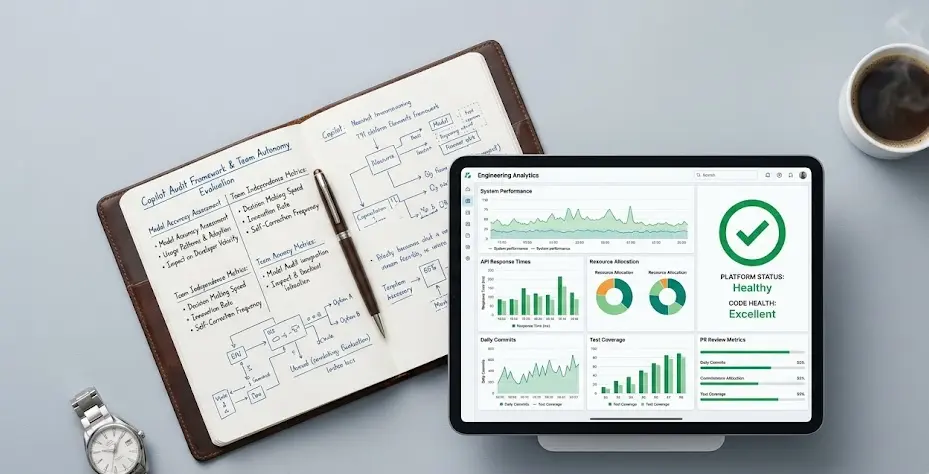
Implementing a Practical Copilot Audit Framework for Tech Leaders
How to conduct a structural evaluation of your development pipelines?
A successful audit begins by mapping your pipeline metrics beyond superficial line-item counts. Executives must track code churn rates alongside deployment frequencies to see if the increased volume is resulting in stable features or triggering recurrent rework cycles. If the same components keep getting revisited for logic adjustments shortly after launch, the team is likely accepting suggestions too quickly.
An effective Copilot audit framework requires checking whether the surface area of the repository is expanding faster than the team can read and maintain it. Volumetric text surges without strict structural control point straight to an accumulation of technical debt. Evaluating the stability of code lifecycles prevents development velocity from becoming an artificial metric that masks core platform fragmentation.
What questions should engineering managers ask during code check-ins?
During regular technical synchronized evaluations or 1-on-1 check-ins, engineering managers should systematically challenge developers to explain the logic paths they recently shipped. Ask the author to explain why a specific structural loop was implemented or how a component manages edge cases under load.
If the developer answers with vague statements or relies on guesswork, it reveals that their mental map of the system has thinned. Verifying human logic ownership ensures that professionals remain active designers rather than passive consumers of automated text, protecting the firm’s capacity to resolve live production outages efficiently without extensive documentation lookups.
How to analyze pull request comments to judge developer autonomy?
Pull request discussions serve as an authentic mirror of a team’s engineering discipline and review culture. When automated tools are used well, review conversations naturally shift upward toward high-level design choices, architectural boundaries, data mutation safety, and system trade-offs.
Conversely, if review comments remain trapped in trying to decode what the code even does, or correcting basic structural style inconsistencies, the team is losing its shared direction. Managers must audit review threads to ensure that approvals require deep logical consensus rather than a simple confirmation of visual completeness. Consider these core review focuses:
- Architectural coupling limits: Checking that modules do not create circular or unnecessary dependencies.
- Design pattern alignment: Ensuring that automated blocks follow the codebase’s established style rules.
- Data flow validation: Reviewing how information moves through adjacent services safely.
Why does skipping the problem-framing phase destroy engineering value?
The highest risk of unguided automation is the tendency for developers to lean on inline suggestions before they have properly framed the problem they are trying to solve. In a weak engineering setup, workers begin skipping the crucial design and decomposition steps, letting the tool define the initial structure of the solution.
At first, this approach feels highly efficient because code appears instantly, but over time it removes the deep critical thinking that prevents bad architecture. Allowing automated software to steer your system design leads directly to fragile software structures. Assistants must be used to speed up the repetitive, boiler-plate parts of coding only after the engineering team has mapped out the shape of the solution manually.
How to align automated suggestions with long-term business goals?
Aligning automated code generation with long-term organizational scalability requires the permanent implementation of clear code legibility rules and strict review discipline. Technology directors must configure their tools to respect the custom design patterns of their enterprise architecture, preventing fragmented code styles from entering active branches. Furthermore, teams should balance feature deployment velocity with an uncompromised commitment to repository cleanup and optimization.
Lo cierto es que the real value of automation is captured when technology serves as a tool to complement, not replace, human intellect. By ensuring that your engineering teams maintain absolute control over every design decision, your organization can scale its digital platforms on a predictable, safe, and highly cost-effective budget, turning code compilation velocity into true business innovation.