AI ROI in Healthcare: Reducing MTTD and Increasing Case Throughput
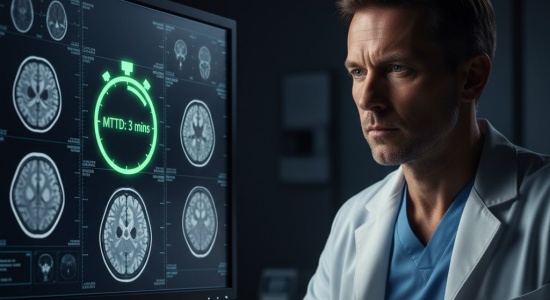
The integration of Artificial Intelligence (AI) into Radiology and Pathology is fundamentally a strategy for operational efficiency. AI’s true value isn’t its ability to replace human judgment, but its capacity to reduce the crucial and costly delays inherent in the diagnostic pipeline. This efficiency translates directly into quantifiable gains for healthcare systems, primarily by accelerating the Mean Time To Diagnosis (MTTD) and significantly increasing the case throughput of specialists.
For hospital administrators and technology investors, quantifying this AI-driven efficiency establishes a clear Return on Investment (ROI) in patient care and financial health. For more details on the transformation, read about healthcare software solutions.
I. The Time ROI: Accelerating Mean Time To Diagnosis (MTTD) ⏱️
MTTD is a critical metric in medicine; the time saved in diagnosis directly correlates with improved patient outcomes, particularly in time-sensitive conditions like cancer or stroke. AI targets the most time-consuming segments of the diagnostic workflow.
Triage and Prioritization:
AI algorithms can scan incoming image stacks (MRIs, CTs) and digital slides faster than any human reviewer. The system instantly flags studies showing critical findings (e.g., pulmonary embolism, acute stroke symptoms).
Operational Impact:
This allows the radiologist to re-prioritize the queue based on AI-identified risk severity, ensuring that life-threatening cases are reviewed in minutes instead of hours. The ROI is measured in faster patient intervention and reduced legal liability.
Lesion Localization and Measurement:
For conditions like cancer, the radiologist spends significant time identifying, localizing, and meticulously measuring the growth of lesions across sequential scans. AI can automate this detection and measurement process.
Operational Impact:
AI instantly highlights suspicious areas and provides precise volumetric measurements. This minimizes the risk of human oversight and cuts down the time spent on tedious manual tracking, allowing the physician to move directly to interpretation.
II. The Throughput ROI: Maximizing Specialist Capacity 📈
Globally, there is a severe shortage of specialized pathologists and radiologists. AI’s operational advantage is its ability to increase the specialist’s capacity without increasing their workload or hours.
Increased Case Volume (Throughput):
By automating localization and pre-screening, AI reduces the amount of time a specialist needs to spend on “normal” scans or routine measurements. This frees up the highly paid physician’s time to focus on complex, ambiguous cases that demand human cognitive expertise.
Quantification:
AI increases the number of cases a specialist can accurately review per hour—a direct and measurable increase in hospital productivity and revenue generation.
Minimizing Fatigue and Oversight:
A human radiologist analyzing hundreds of images during an eight-hour shift is prone to visual fatigue and oversight. The AI acts as a non-fatiguing auditor that maintains consistent vigilance, reducing the likelihood of missed diagnoses (false negatives) caused by human error late in a shift.
Optimizing the Pathologist’s Workflow:
In pathology, AI is vital for analyzing vast digital slides. The machine can quickly scan the entire slide and highlight cell clusters or growth patterns (mitotic counts) relevant to cancer staging. This pre-analysis ensures the pathologist spends their time on high-value interpretation rather than low-value search.
III. Financial and Strategic Impact
The gains in time and volume translate directly to the financial sustainability of modern medicine.
Reducing Operational Costs:
Faster MTTD reduces the length of hospital stays and minimizes the cost of managing delayed treatment complications.
Protecting Patient Trust:
Ultimately, the most significant ROI is the preservation of patient trust. Systems that provide fast, accurate, and reliable results reinforce the hospital’s reputation for quality care, making AI an investment in both efficiency and brand equity.
AI’s true value isn’t its ability to replace human judgment, but its capacity to reduce the crucial and costly delays inherent in the diagnostic pipeline.